
Two award wins, one finalist, and a Certificate III before Year 12
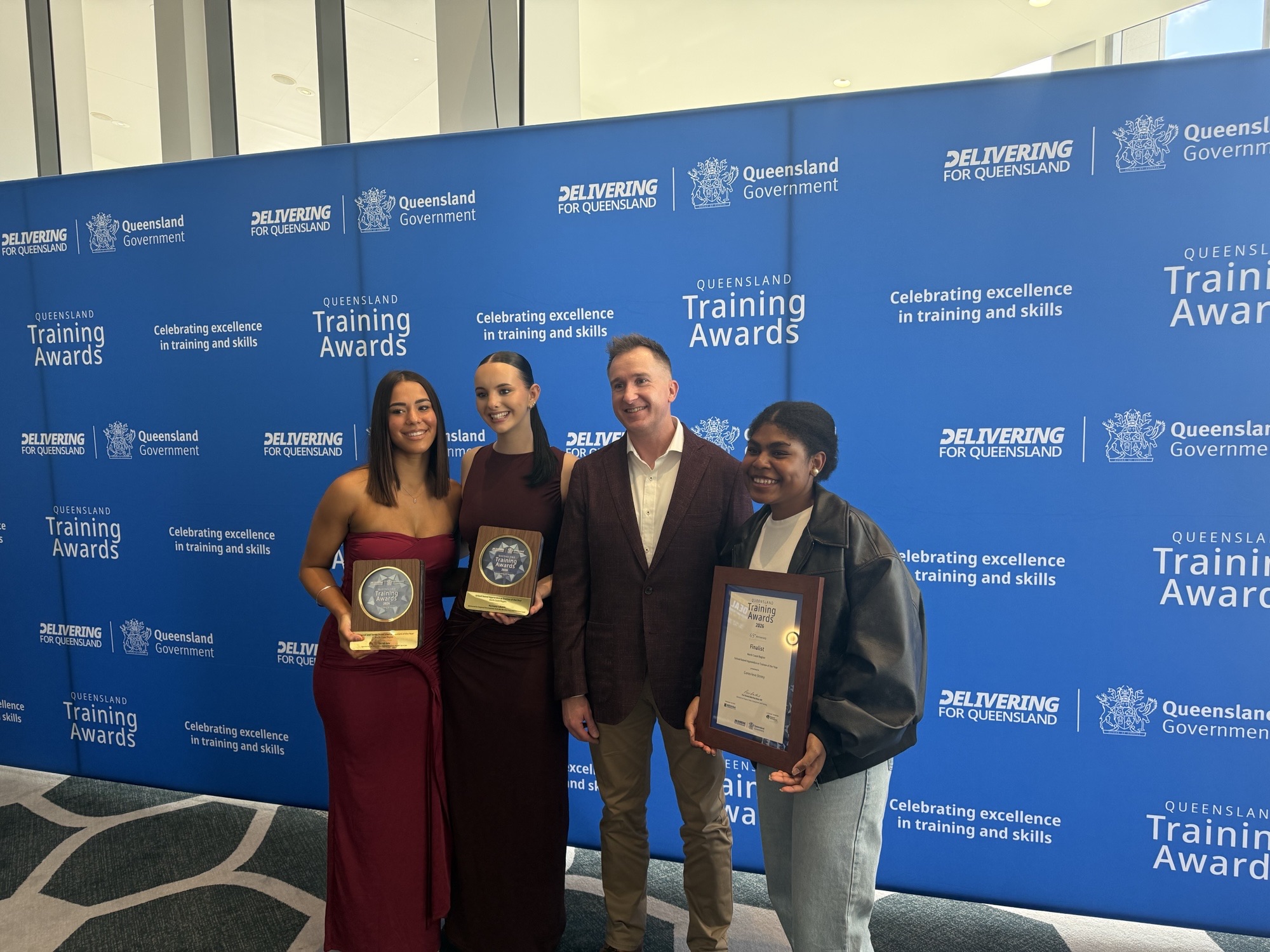
Harmony, Taylah and Genevieve finished HLT33115 Certificate III in Health Services Assistance and 375 hours of hospital experience before school was over. Two are now Queensland state finalists.
375Hours of workplace experience
~400Applicants each year
20Traineeship places
2State finalists
Harmony Lakatos
School-Based Apprentice or Trainee of the Year. Progressing to the Queensland state finals.
Taylah Gela
Aboriginal and Torres Strait Islander Student of the Year. Progressing to the Queensland state finals.
Genevieve Jimmy
Finalist, School-Based Apprentice or Trainee of the Year, North Coast region.
Key points
- Two SWC school-based trainees won their categories at the 2026 Queensland Training Awards North Coast final on 31 July, with a third named finalist.
- All three completed HLT33115 Certificate III in Health Services Assistance plus 50 days (375 hours) of paid employment as part of the traineeship.
- The traineeship runs across Years 11 and 12 in four stages, with the fully support of the student’s own workplace mentor.
- Harmony Lakatos and Taylah Gela progress to the Queensland state finals on 19 September 2026.
At the Queensland Training Awards North Coast regional final on 31 July 2026, Harmony Lakatos was named School-Based Apprentice or Trainee of the Year and Taylah Gela won Aboriginal and Torres Strait Islander Student of the Year. Genevieve Jimmy was a finalist in the school-based category. Harmony and Taylah both progress to the Queensland state finals on 19 September.
What stands out is not the trophies but the timing. All three had already completed their Certificate III in Health Services Assistance and all 50 days, or 375 hours, of practical workplace experience the qualification requires. Before Year 12 was over, all three were employable in the Queensland health system.
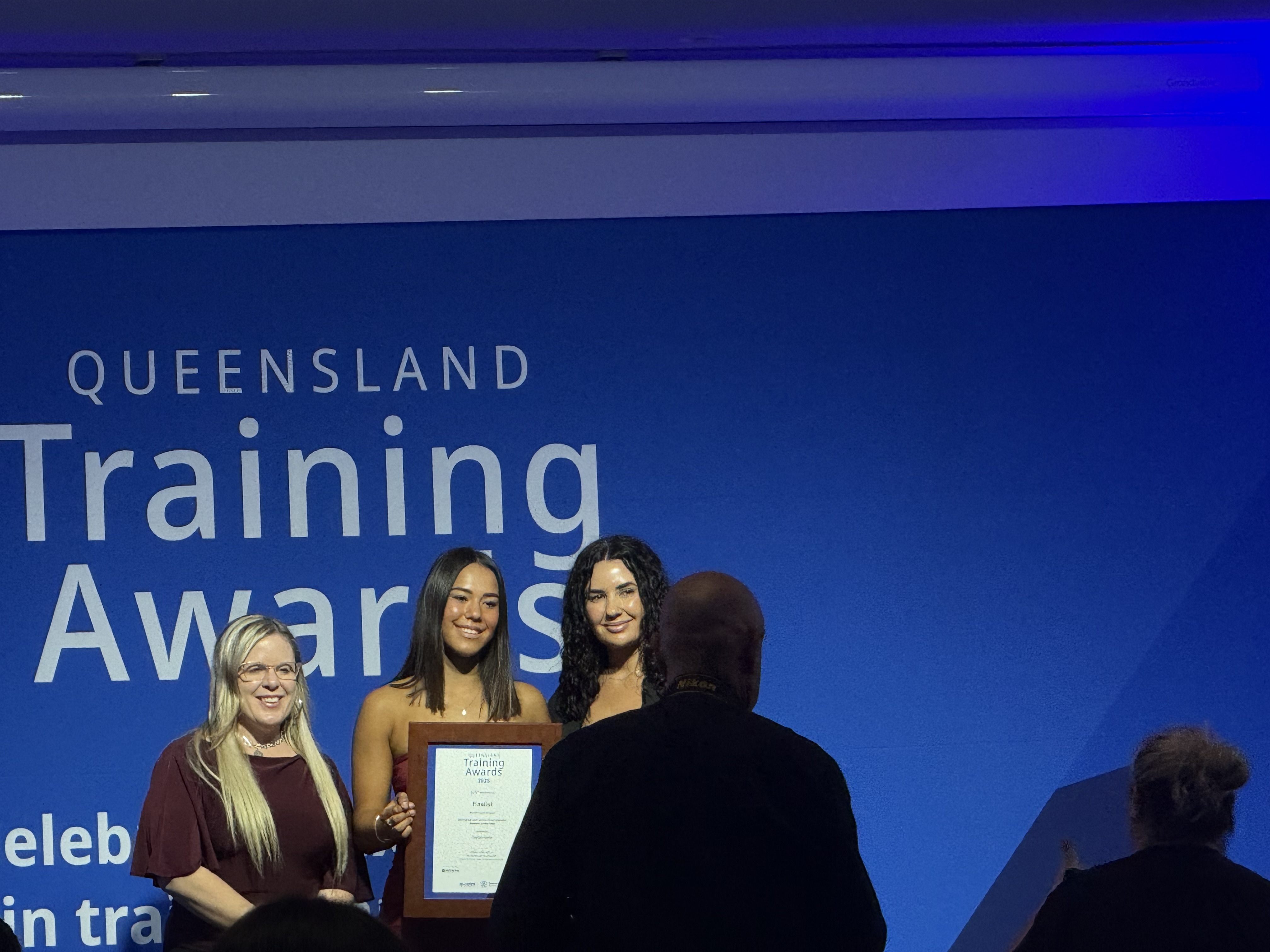
“It’s such an honour to see these three trainees stand on stage and represent the school-based traineeship program so professionally and confidently. These opportunities are just a first step to the beginning of their future.”
Kylie Forward · Coordinator, Education & Youth Engagement · Metro North Health
How the traineeship works
Getting in can be competitive. This host employer has been delivering the program with SWC Training for over 10 years. Selection runs in the second half of the students’ Year 10, through a written application and a series of interviews. In a typical year, this host employer can receive over 400 applications from the local region for roughly 20 positions. That ratio does more than fill a cohort, students who make it know they earned a place hundreds of others missed, and they carry that with them from the first shift.
Enrolment, orientation and onboarding follow at the start of Year 11. Before students set foot on a ward, SWC briefs them on the scope of their role, what is expected of them, and exactly what the Certificate III involves in theory and assessment work.
The qualification is then delivered in four stages across two years: three in Year 11, one in Year 12, with four units of competency in each. The strength of this model lies in its seamless integration of structured learning with practical workplace experience. Rather than relying on simulated classroom exercises, formal competencies are assessed on the job. Students learn, practise, and demonstrate their skills in real time, with their workplace mentor signing off on achievements directly where the work happens.
By the end of Stage 4, in the first half of Year 12, students hold both the qualification and the full 375 hours: a year of real shifts behind them before final exams.
| Program type | School-based traineeship (SBAT) |
| Qualification | HLT33115 Certificate III in Health Services Assistance |
| Year levels | Years 11 and 12 (selection in Year 10) |
| Structure | Four stages, four units of competency each |
| Workplace experience | 50 days (375 hours) |
| Career outcome | Health Services Assistance Roles |
| Region | Queensland North Coast |
| Training organisation | SWC Training, RTO 4567 |
| Host employer | Metro North Health, Caboolture Hospital |
The trainer behind the cohort
Brad Lowe is SWC’s Training Manager for the Northern Region and the trainer who takes this cohort through all four stages. In practice that means facilitating education days, working through the theory with students, and completing workplace theory and practical assessments alongside their mentors and workplace coordinators. When every competency in a stage is verified, it is signed off and the student moves on.
“They can reach out any time they are completing their work and I will endeavour to respond at my earliest convenience, day or night, weekday or weekend.”
Brad Lowe · Training Manager, Northern Region · SWC Training
Alongside that availability sits deliberate flexibility. Qualification expectations, theory deadlines and assessment activities all move so school commitments come first, the goal being to stop the traineeship becoming overwhelming or a distraction from schooling.
Running through both is a firm line on conduct. Students are held to professional, adult standards from their first education day, which is what turns a traineeship into a supported transition into working life rather than just a certificate.
That combination matters most early on. Most students take around three months to settle into the workplace, and the first stage is the hardest to carry alongside school. It is where cohorts are lost. Realistic timeframes, one-on-one guidance through assessment tasks and steady encouragement at that point are what separate a withdrawal from an award nomination two years later.
What Harmony, Taylah and Genevieve ended up sharing was not something a Year 10 interview could have predicted: confidence communicating with patients and colleagues of every age, a proactive approach on the floor, genuine detail in their assessment work, and the time management to carry the traineeship and school at once.

Why employers host
For the students, the traineeship did what no school subject can. It let them find out which areas of health services appeal to them and what a health facility actually feels like to work in, while earning a qualification that lets them start immediately.
For the host employer, the return on training and supporting a trainee is a team member who integrates quickly and already knows the building, the team and the work.
“It’s so great to see how much they achieve and grow in a short amount of time, and to now see them transition into our casual pools every year.”
Kylie Forward · Coordinator, Education & Youth Engagement · Metro North Health
“Covid impacted on nursing teams significantly, and these traineeships have helped to encourage new people to the profession and to show them the multitude of possibilities within the industry.”
Brad Lowe · SWC Training
That is the reframe worth keeping. A school-based traineeship is usually pitched as a student opportunity. On a ward that has spent several years short-staffed, it is also a workforce pipeline.
About SWC Training
SWC Training is a registered training organisation (RTO 4567) and part of IVET Group. Health is its deepest specialisation, with qualifications spanning health services assistance, allied health, pharmacy support, sterilisation services, health administration and theatre technical support, from Certificate III through to Certificate IV and Diploma.
Delivery is workplace-based by design. Training is built around rosters and operational demand, on site, online or blended, so staff and students keep working while they train. SWC holds state government funding contracts in Queensland, New South Wales, Victoria and Western Australia. See our credentials.
Traineeship pathways in health
The Certificate III behind these awards is one of several health qualifications SWC delivers as a school-based traineeship. Each is a genuine entry point to a career rather than a taster.
- The qualification Harmony, Taylah and Genevieve completed. Leads to health services roles across hospital and health service settings.
- Supporting physiotherapy, occupational therapy and speech pathology teams under the direction of an allied health professional.
- Pharmacy support roles in hospital pharmacy departments, covering dispensary support, stock management and ward distribution.
How SBATs work for schools · Browse all SWC courses
Common questions
What qualification do health school-based trainees complete?
Depending on local state authorities, a number of qualifications can be delivered as a school-based traineeship, and the duration and number of work hours will vary accordingly. Please contact us to find out what’s available in your state.
How long does a school-based traineeship take?
Ideally the SBT runs for two years, across Years 11 and 12. Selection typically happens in the second half of Year 10, with students completing in the first half of Year 12, though timing and duration can vary from state to state, so it’s worth confirming details for your location.
Will it interfere with Year 12 results?
No. In fact, depending on the state, a school-based traineeship can actually contribute to a student’s Year 12 results. The program is built around school commitments, not the other way around: theory deadlines and assessment activities flex to fit school schedules, and trainers are available outside business hours for extra support.
What does it cost to host a school-based trainee?
Costs and funding vary from state to state. In most cases the qualification is subsidised through state training subsidies, so the direct cost of delivery is low or nil. Your main investment is the trainee’s wage and staff time for mentoring and supervision. SWC can walk you through the current funding position and eligibility for your state when you get in touch.
Host a school-based trainee in 2027
SWC Training works with hospitals, health services and schools across Australia. Talk to our team about what is possible in your service.